What is augmented reality (AR)?
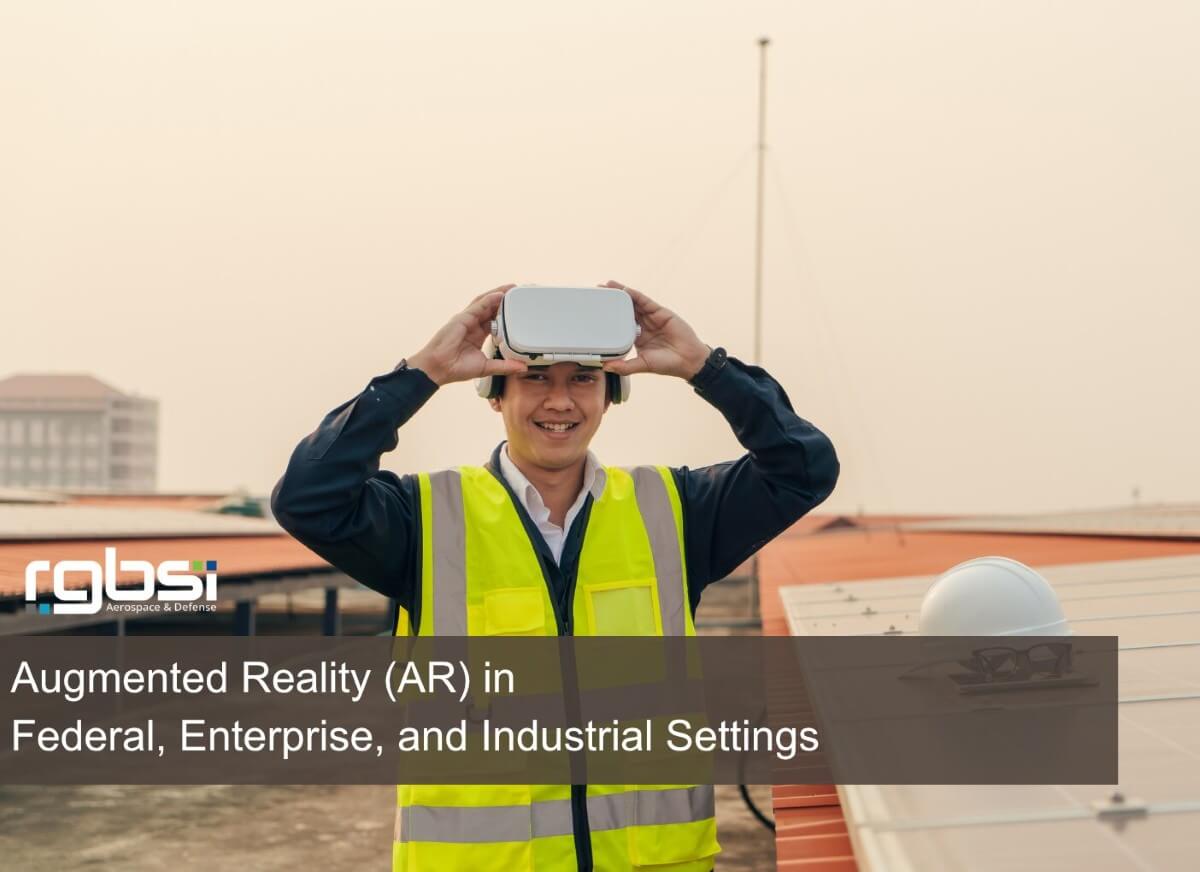
Augmented reality (AR) is a technology overlaying digital objects and information on a screen (either a tablet, phone, or headset) that is capturing the physical environment in real-time.
In enterprise and industrial settings, augmented reality (AR) is used to train new workers on assembly lines and to train industrial workers to perform maintenance and repair operations for different industrial products.
How Is Augmented Reality Used in Industry 4.0/5.0?
In Industry 4.0/5.0, augmented reality transforms the product design and manufacturing lifecycle by overlaying digital information onto physical environments. Engineers and designers can visualize equipment within real-world production spaces, validate spatial requirements, and test virtual prototypes before physical production begins. This improves accuracy, reduces costly design errors, and accelerates development timelines.
AR is also integrated with digital twins, IoT systems, and cloud platforms to provide real time operational data directly within the user’s field of view.
Advantages of Using Augmented Reality in Industry 4.0/5.0
Augmented reality improves efficiency by optimizing operations, ensuring proper material use, and guiding workers through tasks in sequence.
- AR headsets provide hands free access to digital instructions, reducing downtime and manual documentation searches.
- Technicians receive real time data, component highlights, and remote expert support during maintenance or assembly.
- AR improves training, safety, and human centric collaboration between workers and intelligent systems.
- Industrial teams can complete complex tasks with greater speed, accuracy, and consistency.
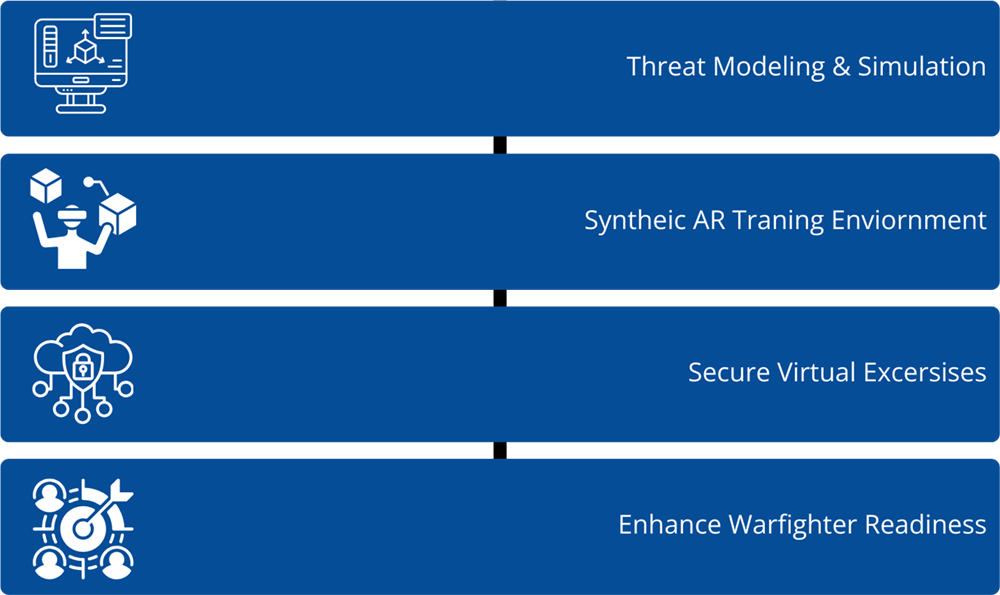
How is AR shaping the future of warfighting?
In addition to AR’s numerous commercial industry applications, federal agencies are utilizing the advanced capabilities which AR offers their warfighting teams. The Air Force Agency for Modeling Simulation plays an increasingly vital role with the USAF’s ability to train warfighters, optimize systems, and evaluate the complexities of an evolving battlespace. Their primary goal is to keep our armed forces prepared to encounter its most worthy adversaries, regardless of the domain.
“The problem we have today is our enemies have got the same technology we have, and our ranges really don’t provide the same experiences they used to,” explained Col. Robert H. Epstein, commander of the Air Force Agency for Modeling and Simulation.
“Everything we’re doing today [with AR] is creating the realism necessary to fight the future fights and the expandability to incorporate the threats that will be coming versus dealing with yesterday’s fight.”
“We don’t want to give away all our capabilities by radiating in free space, so it’s driving us more and more to [figure out] how we can go into a virtualized synthetic environment to allow us to do that training that we think we’ll see in combat,” Epstein said.
Given the importance of warfighter readiness, it is paramount for the military to continuously innovate, advance, and adapt to recent technological changes.